

Civics - by Ada-Elaina Benejan - 11/14/2018


Texto del Guión Gráfico
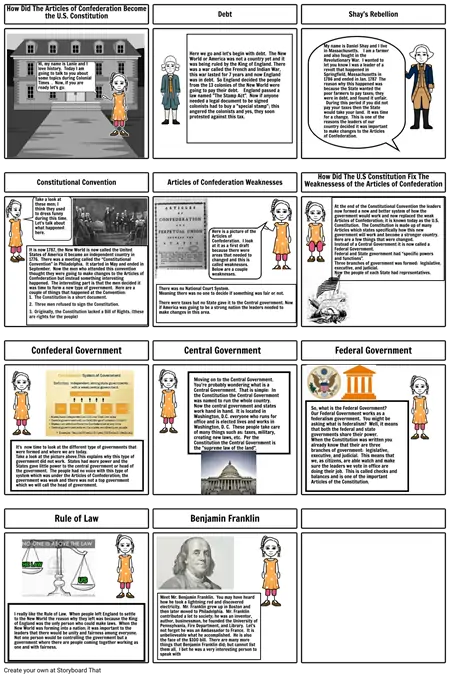
- How Did The Articles of Confederation Become the U.S. Constitution
- Hi, my name is Lanie and I love history. Today I am going to talk to you about some topics during Colonial Times . Now, if you are ready let's go.
- Debt
- Here we go and let's begin with debt. The New World or America was not a country yet and it was being ruled by the King of England. There was a war called the French and Indian War, this war lasted for 7 years and now England was in debt. So England decided the people from the 13 colonies of the New World were going to pay their debt. England passed a law named "The Stamp Act". Now if anyone needed a legal document to be signed colonists had to buy a "special stamp"; this angered the colonists and yes, they soon protested against this tax.
- Shay's Rebellion
- My name is Daniel Shay and I live in Massachusetts. I am a farmer and also fought in the Revolutionary War. I wanted to let you know I was a leader of a revolt that happened in Springfield, Massachusetts in 1786 and ended in Jan. 1787 The reason why this happened was because the State wanted the poor farmers to pay taxes; they were in debt, and found it unfair. During this period if you did not pay your taxes then the State would take your land. It was time for a change. This is one of the reasons the leaders of our country decided it was important to make changes to the Articles of Confederation.
- Constitutional Convention
- Take a look at these men; I think they used to dress funny during this time. Let's talk about what happened here.
- It is now 1787, the New World is now called the United States of America it became an independent country in 1776. There was a meeting called the “Constitutional Convention” in Philadelphia. It started in May and ended in September. Now the men who attended this convention thought they were going to make changes to the Articles of Confederation but instead something interesting happened. The interesting part is that the men decided it was time to form a new type of government. Here are a couple of things that happened at the Convention: 1. The Constitution is a short document. 2. Three men refused to sign the Constitution. 3. Originally, the Constitution lacked a Bill of Rights. (these are rights for the people)
- Articles of Confederation Weaknesses
- Here is a picture of the Articles of Confederation. I look at it as a first draft because there were areas that needed to changed and this is called weaknesses. Below are a couple weaknesses.
- How Did The U.S Constitution Fix The Weaknessess of the Articles of Confederation
- At the end of the Constitutional Convention the leaders now formed a new and better system of how the government would work and now replaced the weak Articles of Confederation; it is known today as the U.S. Constitution. The Constitution is made up of many Articles which states specifically how this new government will work and become a stronger country. Here are a few things that were changed. Instead of a Central Government it is now called a Federal Government. Federal and State government had “specific powers and functions”. Three branches of government was formed: legislative, executive, and judicial. Now the people of each State had representatives.
- Confederal Government
- Central Government
- There was no National Court System. Meaning there was no one to decide if something was fair or not. There were taxes but no State gave it to the Central government. Now if America was going to be a strong nation the leaders needed to make changes in this area.
- Moving on to the Central Government. You're probably wondering what is a Central Government. That is simple: In the Constitution the Central Government was named to run the whole country. Now the central government and states work hand in hand. It is located in Washington, D.C. everyone who runs for office and is elected lives and works in Washington, D. C. These people take care of many things such as: taxes, military, creating new laws, etc. Per the Constitution the Central Government is the "supreme law of the land".
- Federal Government
- So, what is the Federal Government? Our Federal Government works as a federalism government. You might be asking what is federalism? Well, it means that both the federal and state governments share their power. When the Constitution was written you already know that their are three branches of government: legislative, executive, and judicial. This means that we, as citizens, are able watch and make sure the leaders we vote in office are doing their job. This is called checks and balances and is one of the important Articles of the Constitution.
- Rule of Law
- It's now time to look at the different type of governments that were formed and where we are today. Take a look at the picture above.This explains why this type of government did not work. States had more power and the States gave little power to the central government or head of the government. The people had no voice with this type of system which was under the Articles of Confederation; the government was weak and there was not a top government which we will call the head of government.
- Benjamin Franklin
- I really like the Rule of Law. When people left England to settle to the New World the reason why they left was because the King of England was the only person who could make laws. When the New World was forming into a nation; it was important to the leaders that there would be unity and fairness among everyone. Not one person would be controlling the government but a government where there are people coming together working as one and with fairness.
- Meet Mr. Benjamin Franklin. You may have heard how he took a lightning rod and discovered electricity. Mr. Franklin grew up in Boston and then later moved to Philadelphia. Mr. Franklin contributed a lot to society; he was an inventor, author, businessman, he founded the University of Pennsylvania, Fire Department, and Library. Let's not forget he was an Ambassador to France. It is unbelieveable what he accomplished. He is also the face of the $100 bill. There are many more things that Benjamin Franklin did; but cannot list them all. I bet he was a very interesting person to speak with
Más de 30 millones de guiones gráficos creados
¡Sin Descargas, sin Tarjeta de Crédito y sin Necesidad de Iniciar Sesión Para Probar!
